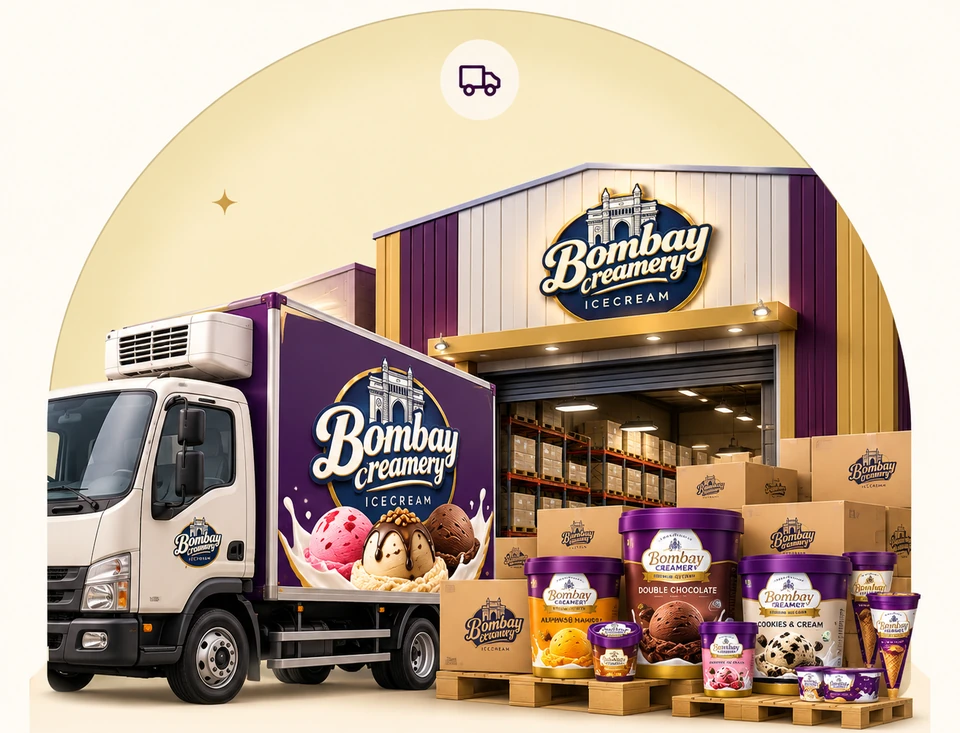
Short answer: an ice cream dealership means holding stock and supplying local shops, cafes and retail points. It suits people with storage, delivery capacity and local trade relationships. This guide covers what the role involves and what to confirm first.
A dealership sits between the brand and the shops that sell ice cream to the public. If you are a trader who already supplies retailers, it may be a natural step. If you are new to frozen products, it helps to understand the work before you commit.
What a dealer does
A dealer generally stocks products and supplies local shops, cafés and other retail points. The day-to-day work usually covers:
- Planning how much stock to hold.
- Taking and coordinating orders from retail customers.
- Keeping stock in suitable frozen storage.
- Delivering to shops on a dependable schedule.
- Keeping records of stock in and stock out.
Our dealership page describes this route for Bombay Creamery.
How it differs from a franchise or distributorship
A dealer does not run a customer-facing outlet, which is what a franchise involves. A dealer also usually works in a smaller area than a distributor, who coordinates supply across a wider territory through dealers and retailers.
What a dealer may need
- Working capital for stock and day-to-day running costs.
- Freezer or cold-storage capacity.
- Temperature control, and backup power where required.
- A delivery vehicle or a dependable logistics arrangement.
- A local retail network, or the ability to build one.
- The business registrations and licences that apply to you.
Planning your local market
Before you apply, look at how many shops and cafés are in your area, which of them could stock ice cream and how far you can reasonably deliver. Our guide to building a retail network goes into this in more detail.
Terms to confirm in writing
- Initial investment and working capital.
- Minimum order quantities and ordering frequency.
- Dealer pricing, margins and payment terms.
- Territory allocation and exclusivity, if any.
- Product availability and supply arrangements.
- Support, schemes or training, if offered.
- Agreement conditions and responsibilities on both sides.
Common mistakes
- Under-estimating the cost and effort of keeping stock frozen.
- Taking on a wider area than your vehicles and staff can serve.
- Relying on verbal promises about territory or support.
- Not allowing for stock that does not sell before it expires.
Key takeaways
- A dealer supplies local retail; the role depends on storage, ordering and delivery.
- Capacity matters: freezers, power backup and transport.
- Pricing, territory and support must be confirmed in writing.
When you are ready, apply for a dealership or ask the team a question.
Compare routes in franchise vs dealership vs distributorship, and see cold-chain basics. The dealership page has the opportunity overview.
This article gives general information only. It is not financial, legal or tax advice, and it does not state the terms of any Bombay Creamery opportunity. Terms are confirmed in writing.